These records are found in the online catalog of The Mariners’ Museum and Park in Newport News, Virginia. Uncurated search results are presented to give researchers and interested readers an idea of whether the museum’s archives contain information about this vessel and whether it may be worthwhile to visit the museum’s catalog search page for further investigation. Uncurated results may be inaccurate or incomplete.
Mariners Museum online catalog search, July 12, 2026. Search phrase: "Uncle Sam". Catalog returned 33 records; this selection table includes 33 records fetched through catalog result pages.
Use these buttons to send uncurated search results to your own app or text document for further research. First, check the box for any row, or click "Select All" then uncheck any rows. Then click "Show Selections". You can then copy your selections from the text box and past them into your app.
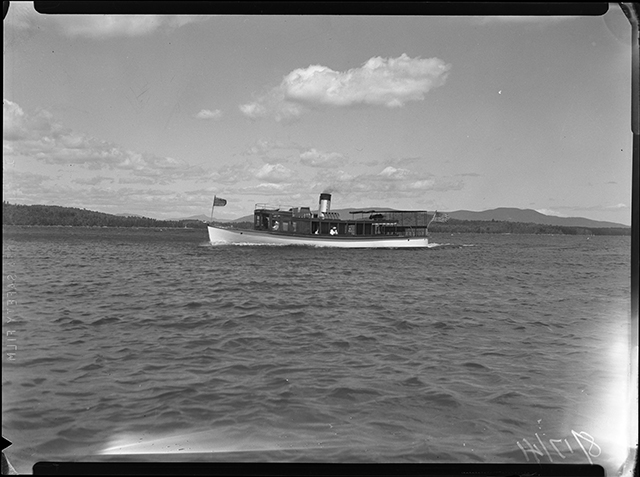
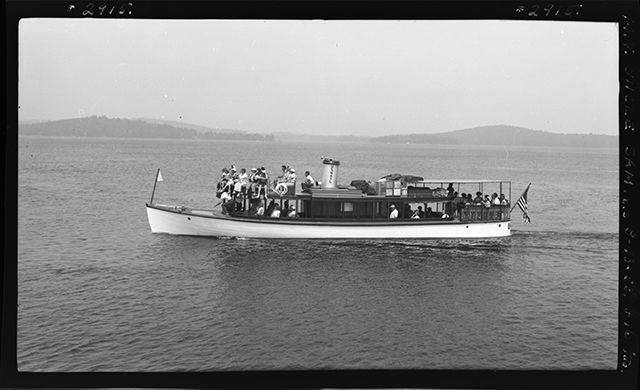
Broadside view of the police boat Uncle Sam under way. The stack is marked U.S. Mail. The upper deck has a number of people riding on it, including young people with their legs hanging over the edge under the railing.
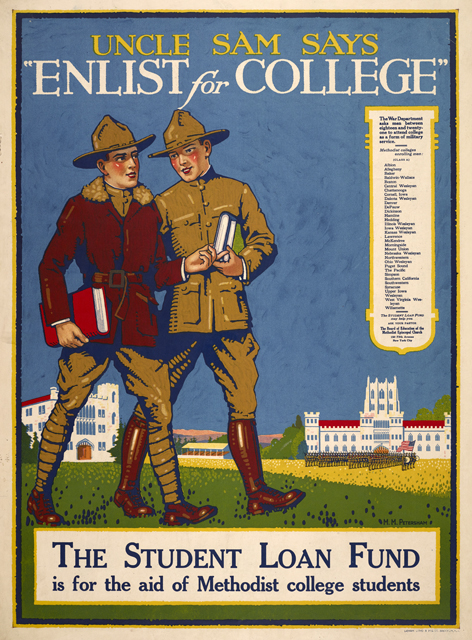
SHORT DESCRIPTION: Poster showing two men in uniform walking along campus carrying school books. Text at right states "The War Department Asks Men Over 18 To Attend College As A Form Of Military Service" which is followed by a list of Methodist colleges enrolling men. NOTES: Printed by Latham Litho & Printing Co. Brooklyn for Board of Education of the Methodist Episcopal Church. Early GI bill type program known as the Students Army Training Corps. NOTES: Artist Maud Fuller Petersham was born in Kingston, New York in 1890, the daughter of a Baptist minister and Quaker grandparents. She graduated from Vassar College in 1912 and then attended the NY School of Fine and Applied Arts. Her first job was with the International Art Service and there she met a young commercial artist from Hungary, Petrezselyem Mihaly. At first he was Maud's tutor, but eventually they married in 1917 and began creating children's literature. Many of their books were bible based and their writings included stores about Miska as a young child in Hungary, early U.S. history and nursery rhymes. Because his name was so difficult to pronounce, Mihaly changed his name to Miska Fuller Petersham after the couple married. He was born in Hungary in 1888, arrived at Ellis Island in 1912, and he was called up for military service during WWII, enlisting on 6 August, 1942. Miska was still in the military in 1954 according to a WWII hospital admission card from that year. The couple worked as a team, authoring their books and signing artwork as M.M. Petersham.
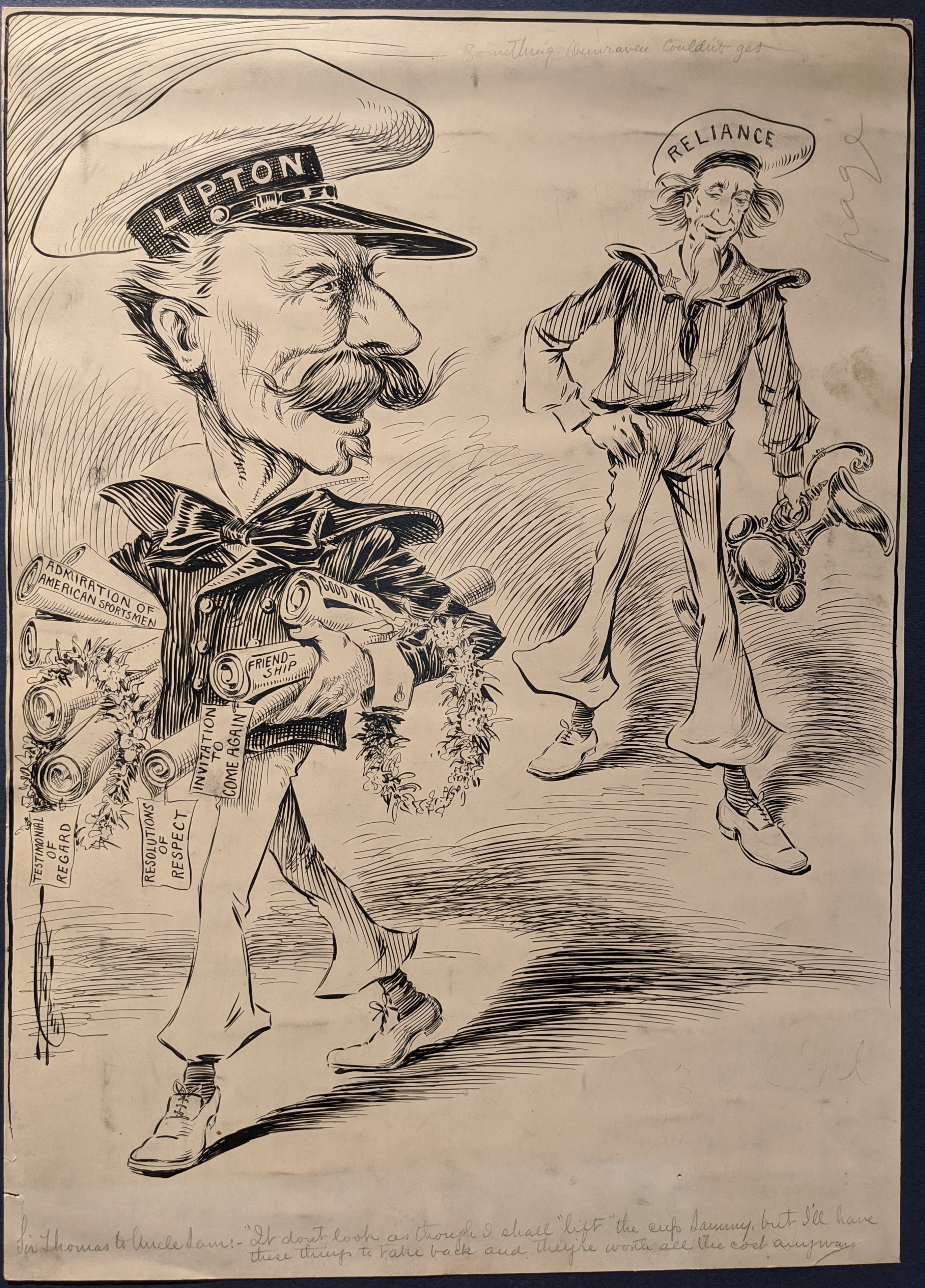
SHORT DESCRIPTION: Pen and ink drawing. The image is a cartoon related to the 1903 America’s Cup race between Sir Thomas Lipton’s Shamrock III and the New York Yacht Club’s Reliance. The artist was a cartoonist named Chapin (there were several cartoonists with this last name at the time of the race). The artist has supplied two possible captions: “Sir Thomas Lipton to Uncle Sam: It doesn’t look as though I shall ‘lift’ the Cup Sammy, but I’ll have these things to take back and they’re worth all the cost anyway.” and “Something Dunraven couldn’t get.” The image shows Sir Thomas Lipton at the left with scrolls labeled "ADMIRATION OF AMERICAN SPORTSMENT,"TESTIMONIAL OF REGARD," RESOLUTIONS OF RESPECT," "INVITATION TO COME AGAIN," "FRIENDSHIP," and "GOODWILL" and several wreaths under his arms. Lipton looks over his shoulder to Uncle Sam wearing a hat labeled "RELIANCE" and holding the America's Cup trophy in his left hand. NOTES: The 1903 America's Cup, the 12th challenge for the Cup. It took place in the New York City harbor and consisted of a best of five series of races between Reliance, the fourth of Nathanael Herreshoff's defenders for the cup, entered by the New York Yacht Club; and Shamrock III, representing the Royal Ulster Yacht Club and also the third of Sir Thomas Lipton's Cup challengers. Reliance successfully defended the Cup winning the first three races. VESSEL INFORMATION: VESSEL NAME: RELIANCE VESSEL TYPE: YACHT VESSEL BUILT: 1903 DESIGNER: NATHANAEL HERRESHOFF BUILDER: HERRESHOFF MANUFACTURING COMPANY BUILDER LOCATION: BRISTOL, RHODE ISLAND DIMENSIONS: 143’8” length overall, 89’8” waterline length, 25’8” beam, 20’6” draft, 140 tons displacement SHIPOWNER: C. Oliver Iselin and syndicate CAPTAIN: CHARLES BARR HOME PORT: NEW YORK, NEW YORK; NEW YORK, MANHASSET BAY SCRAP DATE: One month after the race was completed VESSEL HISTORY: Reliance was a giant. Although her waterline length was 90 feet, large overhangs at the bow and stern which increased its waterline when sailing from 90’ to over 131’—a tremendous source of speed. Reliance had a highly polished Tobin bronze hull reduced frictional resistance by an astounding 10%. Reliance’s thin 102-ton deep plunging fin-shaped keel counterbalanced its 196-foot tall mast and carried 16,159 square feet of sail. Reliance was fitted with many new innovations like a steel-welded mast with telescopic topmast; two wheels, one with a foot brake to give the helmsman a break; ingeniously designed winches dotted Reliance’s deck in order to handle the enormous loads generated by its large, specially-designed sails; and a hollow rudder that could be filled or emptied of water to help balance the steering.
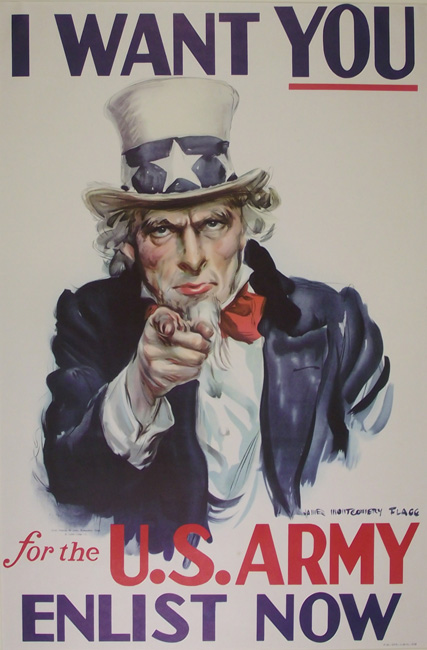
SHORT DESCRIPTION: WWI recruiting poster showing Uncle Sam pointing his finger at the viewer, encouraging young men to enlist in the Army. The design was created in 1917 by James Montgomery Flagg shortly after the United States entered the war. He was most likely was inspired by a 1914 poster by the British illustrator Alfred Leete, which featured Lord Kitchener, the British Secretary of State for War, pointing at the viewer and declaring, "Your Country Needs YOU." Even before he made this poster, Flagg was responsible for reinterpreting the image of Uncle Sam, who previously had been portrayed as a sedentary old man. Flagg portrayed Uncle Sam as active and authoritative for the cover of the July 16, 1916, issue of Leslie's Weekly, accompanied by the title "What Are You Doing for Preparedness?" Flagg later used this image of Uncle Sam in his iconic poster, which was intended to encourage young men to enlist in the Army. The poster is the best known of some 46 works that Flagg created to support the war effort. Flagg himself called his creation "the most famous poster in the world." NOTES: James Montgomery Flagg was born in New York in 1877. As a child he began to draw and sold his first drawing at the age of 12. Two years later he was contributing to Life Magazine and at fifteen was on the staff of the The Judge. Flagg studied at the Arts Students League in New York from 1894-1898 and then spent a year studying in London in 1899, followed by a year in France. He was one of America's leading illustrators and his work was used in Photoplay, McClure's Magazine, Collier's Weekly, Ladies' Home Jounal, Cosmopolitan, Saturday Evening Post and Harper's Weekly. During the First World War Flagg designed 46 posters for the government of which his Uncle Sam poster with the caption "I Want You for the U.S. Army" is considered the most famous. An adapted version of this poster was also used during the Second World War. Not only did Flagg created art for books, magazine covers, comic books, political and humorous cartoons, advertising and spot drawings, he also painted portraits, including those of Mark Twain, actress Ethel Barrymore and boxer Jack Dempsey. Flagg's most famous poster, and the first image he created for Frank Leslie's illustrated Newspaper was his 1917 depiction of Uncle Sam. Flagg may have used his own face for the gentleman, adding age lines and a white goatee, or he may have based Uncle Sam on his neighbor Walter Butts. He volunteered his skills to the Division of Pictorial Publicity (DPP), a group initially established by Charles Dana Gibson in an effort to use illustrations to promote the war effort. The DPP was quickly absorbed by Woodrow Wilson's Committee on Public Information.
CAIRO - ILLINOIS - UNITED STATES - Related Place; NEW MADRID - MISSOURI - UNITED STATES - Related Place; CORINTH - MISSISSIPPI - UNITED STATES - Related Place; LONDON - ENGLAND - Publisher
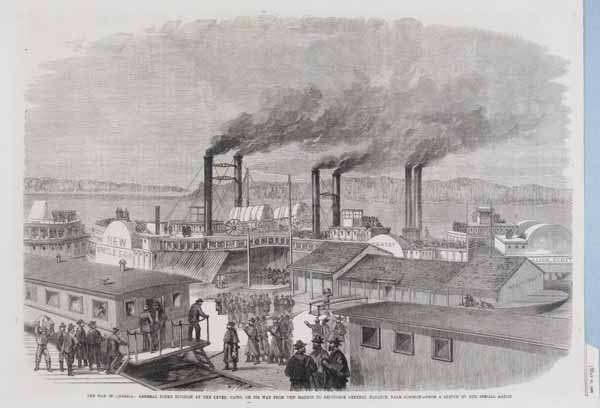
SHORT DESCRIPTION: The print shows a very busy riverfront along the Mississippi River, with several steamboats loaded for departure. The decks are crowded with people and wagons, and in the foreground there are two railroad cars with soldiers marching nearby. The boats are marked New Uncle Sam, Yankey (should be Yankee), and Alick Scott (should be Aleck Scott), and wharf boat. NOTES: Image is from page 554 of The Illustrated London News, published May 31, 1862.
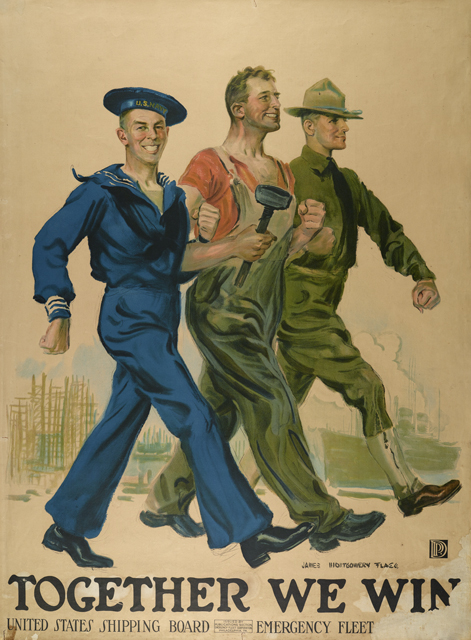
SHORT DESCRIPTION: World War I poster showing a sailor, construction worker and a soldier striding in unison with their arms linked together. There is a silhouette of a merchant ship in the background. NOTES: Produced by the United States Shipping Board Emergency Fleet Corporation, it conveys the message that work at home was as important as being a soldier. The Shipping Board's task was to produce enough cargo ships to supply the troops in Europe with food and munitions of war. On January 31, 1917, Germany announced a policy of unrestricted submarine warfare. The submarines wreaked havoc on ships in the North Atlantic, and the United States needed to find a way to replenish lost cargo ships as well as build new ones. The Shipping Board Emergency Fleet Corporation was given that task. NOTES: Artist James Montgomery Flagg (1877-1960) was famous for his WWI posters and he produced a handful of powerful and effective propaganda posters for WWII. He was an Amercian artist and illustrator who created art for books, magazine covers, comic books, political and humorous cartoons, advertising and spot drawings. He also painted portraits, including those of Mark Twain, actress Ethel Barrymore and boxer Jack Dempsey. Flagg studied at the Art Students Leage of New York from 1894 to 1898 and then in London and Paris from 1898 to 1900. By age 12, his illustrations had been accepted by national magazines and by 14, he was a contributing artist for Life. Flagg's most famous poster, and the first image he created for Frank Leslie's illustrated Newspaper was his 1917 depiction of Uncle Sam. Flagg may have used his own face for the gentleman, adding age lines and a white goatee, or he may have based Uncle Sam on his neighbor Walter Butts. He volunteered his skills to the Division of Pictorial Publicity (DPP), a group initially established by Charles Dana Gibson in an effort to use illustrations to promote the war effort. The DPP was quickly absorbed by Woodrow Wilson's Committee on Public Information.
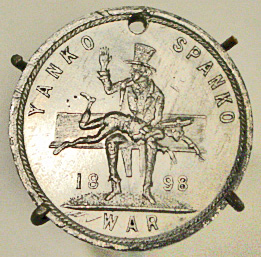
SHORT DESCRIPTION: The obverse depicts Uncle Sam seated on a bench spanking a Spaniard wearing a sombrero lying face down across his knees. With the legend: YANKO SPANKO at the top and 1899 and WAR below. The reverse bears the inscription- DEWEY, REMEMBER THE MAINE, HE DID. The token has a hole drilled at the top center that was probably not a part of the original manufactuing process. The token was manufactured by the Hutchins Manufacturing Company of Springfield, Massachusetts.
4. Col. John R. Fountain, 07926, of Marshal, Michigan, Commanding Officer, Camp Patrick Henry, Va., awarding "commendation" to the "Queen of the Ball" at the Military Police Company party at the Last Chance Night Club, Camp Patrick Henry. The MP party marked the official opening of the club on 5 Aug 45.
Shows the stage of the Last Chance night club, on stage are five men in drag. They are joined by Col. Fountain at the microphone and another man as Uncle Sam.
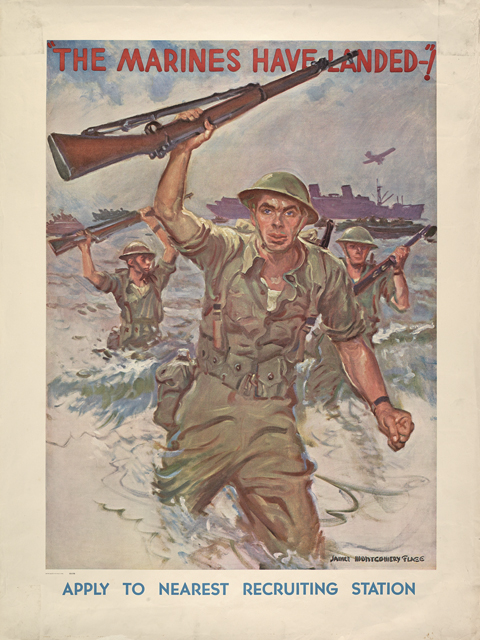
SHORT DESCRIPTION: Recruiting poster showing three Marines storming a beach. View includes waves around the Marines' legs and silhouettes of ships and planes in the background. NOTES: First printing, done just days after Pearl Harbor. Artist James Montgomery Flagg (1877-1960) was famous for his WWI posters and he produced a handful of powerful and effective propaganda posters for WWII. He was an Amercian artist and illustrator who created art for books, magazine covers, comic books, political and humorous cartoons, advertising and spot drawings. He also painted portraits, including those of Mark Twain, actress Ethel Barrymore and boxer Jack Dempsey. Flagg studied at the Art Students Leage of New York from 1894 to 1898 and then in London and Paris from 1898 to 1900. By age 12, his illustrations had been accepted by national magazines and by 14, he was a contributing artist for Life. Flagg's most famous poster, and the first image he created for Frank Leslie's illustrated Newspaper was his 1917 depiction of Uncle Sam. Flagg may have used his own face for the gentleman, adding age lines and a white goatee, or he may have based Uncle Sam on his neighbor Walter Butts. He volunteered his skills to the Division of Pictorial Publicity (DPP), a group initially established by Charles Dana Gibson in an effort to use illustrations to promote the war effort. The DPP was quickly absorbed by Woodrow Wilson's Committee on Public Information.
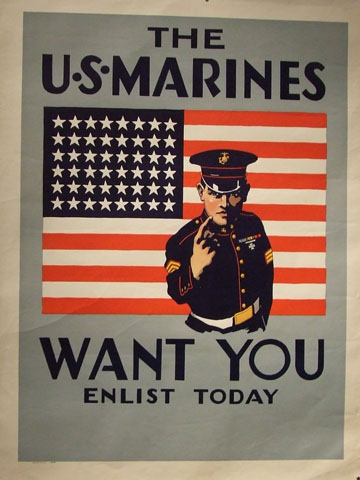
SHORT DESCRIPTION: Recruiting poster showing a Marine in front of a 48 star flag with his right hand and extended index finger raised. The hand and half of the Marine's face are shadowed, lending emphasis to the finger and beckoning the viewer towards him. The soldier is shown wearing a blue Dress uniform. NOTES: First printing, done just days after Pearl Harbor. Artist James Montgomery Flagg (1877-1960) was famous for his WWI posters and he produced a handful of powerful and effective propaganda posters for WWII. He was an Amercian artist and illustrator who created art for books, magazine covers, comic books, political and humorous cartoons, advertising and spot drawings. He also painted portraits, including those of Mark Twain, actress Ethel Barrymore and boxer Jack Dempsey. Flagg studied at the Art Students Leage of New York from 1894 to 1898 and then in London and Paris from 1898 to 1900. By age 12, his illustrations had been accepted by national magazines and by 14, he was a contributing artist for Life. Flagg's most famous poster, and the first image he created for Frank Leslie's illustrated Newspaper was his 1917 depiction of Uncle Sam. Flagg may have used his own face for the gentleman, adding age lines and a white goatee, or he may have based Uncle Sam on his neighbor Walter Butts. He volunteered his skills to the Division of Pictorial Publicity (DPP), a group initially established by Charles Dana Gibson in an effort to use illustrations to promote the war effort. The DPP was quickly absorbed by Woodrow Wilson's Committee on Public Information.
SHORT DESCRIPTION: The obverse depicts a steamship, presumably the ANCON, passing through a canal lock. With the legend: PANAMA CANAL OPENED BY S.S. ANCON, Official Souvenir, the date Aug. 15, 1914 in exergue. The reverse depicts a full standing view of Uncle Sam with a pick over his right shoulder and a shovel in his left hand. A bird's eye view of Central America is behind him. With the legend: PANAMA CALIFORNIA EXPOSITION SAN DIEGO 1915. There is a little knob at the top that might be ther remnants of a hanging ring. VESSEL INFORMATION: SS ANCON was an American steamship that became the first ship to officially transit the Panama Canal in 1914. The steamer began life as the SS SHAWMUT, built for the Boston Steamship Line in 1902. About 1910 she was purchased by the Panama Railroad Company to provide shipping required for the construction of the Panama Canal. The name was changed to ANCON. ANCON and her sister ship CRISTOBAL played a crucial role in building the canal, bringing workers and supplies, notably massive amounts of cement, from New York to Panama for the construction project. On August 15, 1914 ANCON made the first official transit of the canal as part the canal's opening ceremonies. ANCON was acquired by the United States Navy from the US Army just after the end of World War I and fitted out as USS Ancon (ID-1467), a troop transport to return Americans home. The Panama Railroad Company replaced SS ANCON in 1938 with a second SS ANCON, a larger steam turbine cargo liner. NOTES: Official Medals below designed by C. K. Berryman, Cartoonist for Washington Star; engraved by C. E. Barber; struck in Mint Exhibit on grounds. This was first and only official exposition medal with Uncle Sam as main design; also striking of this issue for both years of exposition represented first occasion "where medal of this character had been minted and dated for different years." Alternate vessel names: (1) SHAWMUT (SCREW SCHOONER: 1902-1909); (2) ANCON (SCREW SCHOONER: 1910-1918); (3) ANCON (SCREW STEAMSHIP: 1919-1940); (4) USS ANCON (TRANSPORT: 1919); (5) PERMENENTE (SCREW STEAMSHIP: 1941-1946); (6) TIDEWATER (SCREW STEAMSHIP: 1947-1948); (7) CONTINENTAL (SCREW STEAMSHIP: 1949-1950).
185 SUMMER STREET - BOSTON - MASSACHUSETTS - UNITED STATES - Lithographer/Publisher
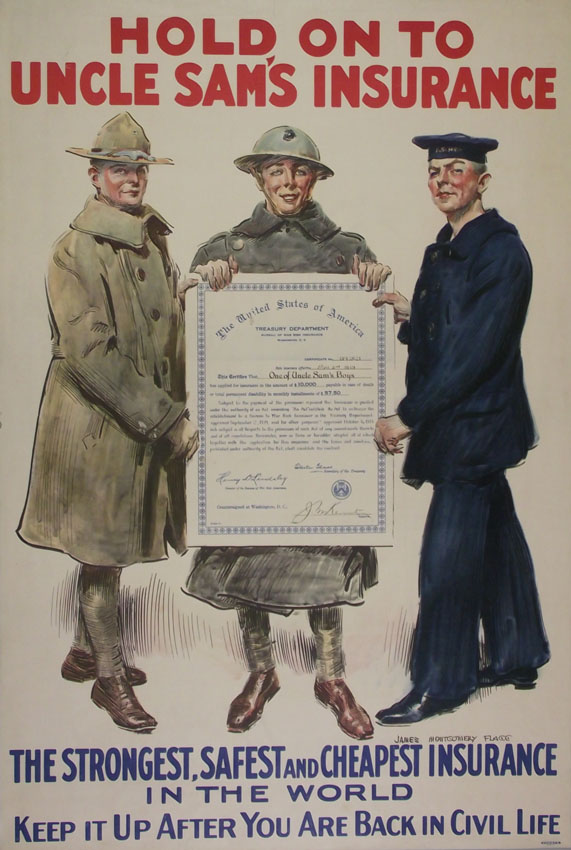
SHORT DESCRIPTION: World War I-era poster depicting two soldiers and a sailor holding up a large insurance certificate for $10,000, issued by the Treasury Department dated March 2, 1918, encouraging returning servicemen to maintain their war risk insurance coverage. NOTES: Poster issued by the Treasury Department, Bureau of War Risk Insurance. James Montgomery Flagg was born in New York in 1877. As a child he began to draw and sold his first drawing at the age of 12. Two years later he was contributing to Life Magazine and at fifteen was on the staff of the The Judge. Flagg studied at the Arts Students League in New York from 1894-1898 and then spent a year studying in London in 1899, followed by a year in France. He was one of America's leading illustrators and his work was used in Photoplay, McClure's Magazine, Collier's Weekly, Ladies' Home Jounal, Cosmopolitan, Saturday Evening Post and Harper's Weekly. During the First World War Flagg designed 46 posters for the government of which his Uncle Sam poster with the caption "I Want You for the U.S. Army" is considered the most famous. An adapted version of this poster was also used during the Second World War. Not only did Flagg create art for books, magazine covers, comic books, political and humorous cartoons, advertising and spot drawings, he also painted portraits, including those of Mark Twain, actress Ethel Barrymore and boxer Jack Dempsey. He volunteered his skills to the Division of Pictorial Publicity (DPP), a group initially established by Charles Dana Gibson in an effort to use illustrations to promote the war effort. The DPP was quickly absorbed by Woodrow Wilson's Committee on Public Information.
SHORT DESCRIPTION: Colored poster on board advertising Maritime Day (May 22nd). The image is titled "American Ships Serve You!". It shows a picture of Uncle Sam steering a wooden wheel marked "farm, home, defense" with his left hand while his right hand is on the handle of an engine telegraph set to full speed. The artist's name, Wilbinson, is at the lower right under the wheel steering station. The poster was issued by the Federal Maritime Board, Maritime Administration and U.S. Department of Commerce some time in the 1950s. NOTES: The United States Federal Maritime Board was an agency within the U.S. Department of Commerce, responsible for certain aspects of merchant shipping between 1950 and 1961. The agency was established in 1950 when the U.S. Maritime Commission was abolished and its responsibilities split between two new agencies: the Federal Maritime Board and the U.S. Maritime Administration (MARAD). The Federal Maritime Board was abolished in 1961, when U.S. shipping laws were separated into two categories: regulatory and promotional. The regulatory role was assigned to the newly created Federal Maritime Commission, while the promotional role was assigned to MARAD. Each year, on May 22nd, the United States celebrates National Maritime Day, a holiday in observance of the contributions of the men and women of the U.S. merchant marine, as well as the U.S. maritime industry and the benefits it brings to the country in terms of transportation, jobs, goods, recreation and national security. The date May 22 is significant because it marks the day that the SS Savannah in 1819 departed on the first successful voyage by a steam-powered ship across the Atlantic, quietly sparking a new age of maritime travel and transport. National Maritime Day was first declared by Congress in 1933, but the holiday took on a special significance in World War II when members of United States Merchant Marine transported necessary supplies and services to troops abroad, all while suffering an extraordinarily high casualty rate.
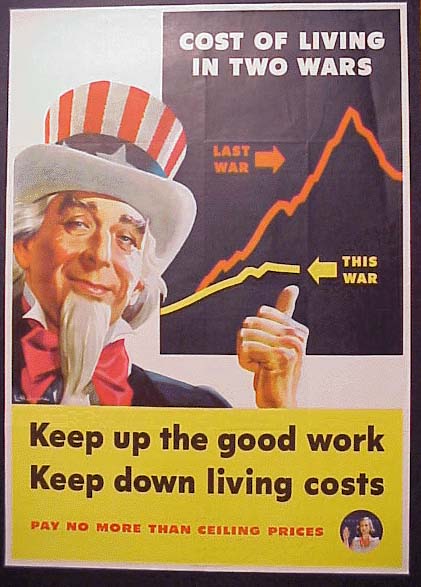
NOTES: [From University of Illinois website] During the first World War the United States experienced a very high rate of inflation, 62%. To avoid this during World War II, the Office of Price Administration (OPA), which administered the controls over prices for consumer goods, began an anit-inflation campaign. The OPA encouraged women to shop carefully and to observe price caps posted in stores.Rationing of food and gasoline during this time also promoted fair access to scarce consumer goods. Overall this effort was successful because between 1940 and 1945 the cost of living in America rose only 28%.
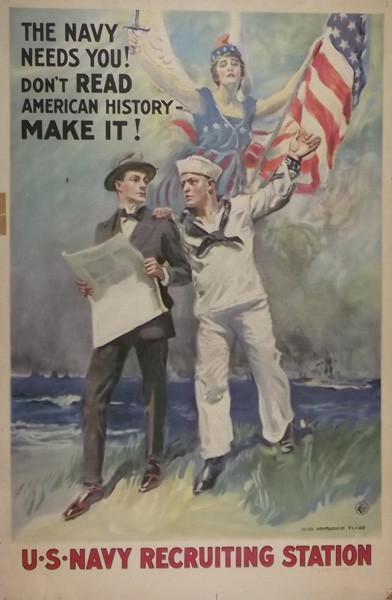
SHORT DESCRIPTION: Recruiting poster depicting a sailor urgently grasping the shoulder of an elegantly dressed male civilian reading a newspaper. The sailor gestures towards the warships on the horizon. A winged Liberty, holding a sword and the American flag hovers concernedly above the two men. The poster was commissioned by the New York Mayor's Committee on National Defense. NOTES: James Montgomery Flagg was born in New York in 1877. As a child he began to draw and sold his first drawing at the age of 12. Two years later he was contributing to Life Magazine and at fifteen was on the staff of the The Judge. Flagg studied at the Arts Students League in New York from 1894-1898 and then spent a year studying in London in 1899, followed by a year in France. He was one of America's leading illustrators and his work was used in Photoplay, McClure's Magazine, Collier's Weekly, Ladies' Home Jounal, Cosmopolitan, Saturday Evening Post and Harper's Weekly. During the First World War Flagg designed 46 posters for the government of which his Uncle Sam poster with the caption "I Want You for the U.S. Army" is considered the most famous. An adapted version of this poster was also used during the Second World War. Not only did Flagg create art for books, magazine covers, comic books, political and humorous cartoons, advertising and spot drawings, he also painted portraits, including those of Mark Twain, actress Ethel Barrymore and boxer Jack Dempsey. Flagg volunteered his skills to the Division of Pictorial Publicity (DPP), a group initially established by Charles Dana Gibson in an effort to use illustrations to promote the war effort. The DPP was quickly absorbed by Woodrow Wilson's Committee on Public Information. The Mayor’s Committee on National Defense was a mostly volunteer organization whose mission was to aid the city of New York in any war related activities. The committee had bureaus and subcommittees related to everything from nationalism, sanitation, and labor that worked to recruit soldiers, help returning soldiers find work, find ways to entertain soldiers temporarily stationed in the city, and promote the war effort. This poster is one of many that was commissioned by the Committee.
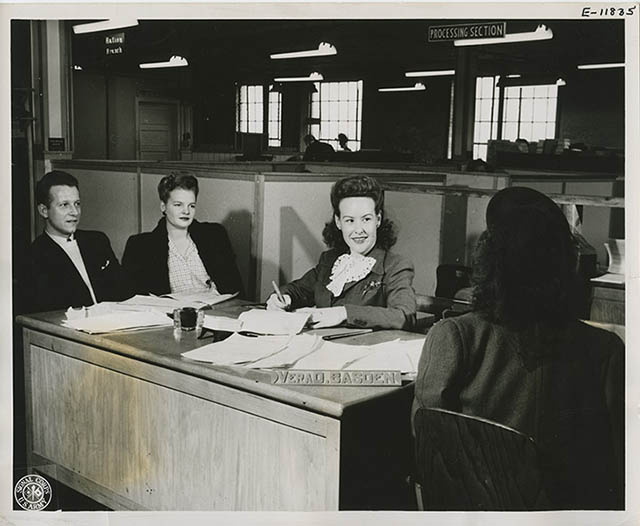
THe initial step towards a job to help speed victory. Receptionist Vera E. Basden, 4601 E, Prince Ann Rd., Fox Hall, Norfolk, Va., home, Dallas, Tex., is shown interviewing applicants for victory jobs in the office of Civilian personnel at the Norfolk Army Base, HRPE, Norfolk, Va. Miss Basden is interviewing Mrs. Dorothy Story, 4127 Columbus Ave., Norfolk, Va., while Mr. Anthony Shalaew, 1309 Brunswick Ave., Norfolk, Va., home, Brooklyn, N.Y. and Miss Sarah E. Jones, 200 W. 35th St., Norfolk, Va., home, Brooklyn, N.Y. Both Mrs. Story and Miss Jones are natives of Norfolk. All three went to work for Uncle Sam the following morning. Photo taken at NAB, HRPE, Norfolk, Va.
Employment interviewing–Virginia–Norfolk.
One woman is speaking to another woman whose back is facing the camera. A man and a woman to the left of the conversation appear to be waiting.
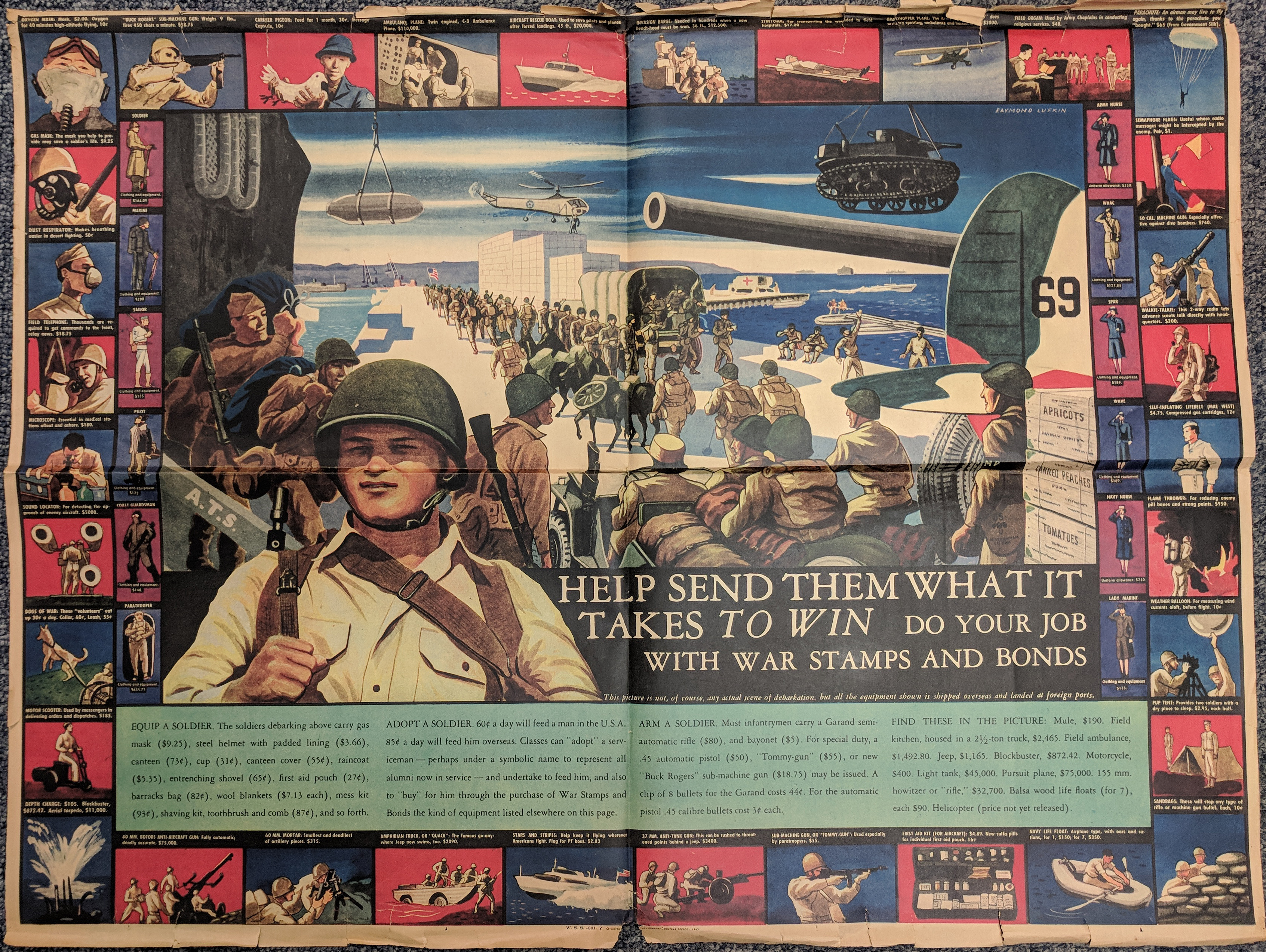
SHORT DESCRIPTION: Poster, World War II war bond, titled "Help Send Them What it Takes To Win" by Raymond Lufkin. Published by the US Government Printing Office in 1943. The poster shows a soldier in the foreground and an embarkation area in the background. Piles of canned goods sit on a battleship while a tank and missile are being lowered from above. A helicopter flies above. Around this central image is a border of illustrations depicting equipment used by armed forces. Above or below each illustration is the cost of the item. Images around the outside show what equipment can be purchased for specific amounts. On the reverse are details of "what your war savings stamps and bonds will buy,"The NEW Schools-at-War Jeep Campaign," and "Suggestions how to use this wall chart." The poster has been folded and is not backed.
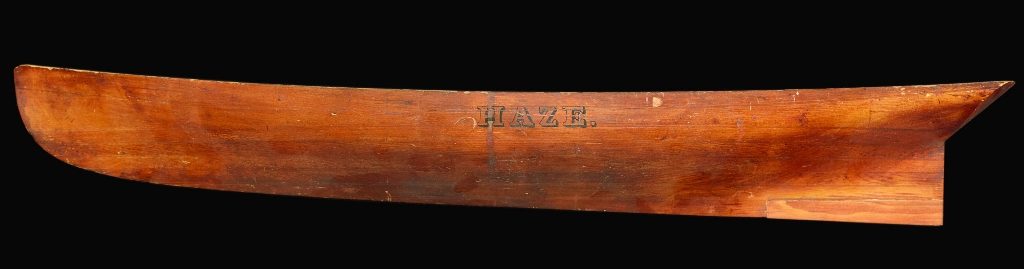
SHORT DESCRIPTION: Builder’s half hull model, port side, made by George Steers of the schooner Haze. The model is a basic representation of the vessel's molded lines, without constructional details. The model is not mounted on a backing board. The model is varnished and is inscribed in black-outlined letters “HAZE.” The model has a plum stem and a raked hour-glass shaped upper stern (no counter). It has moderate deadrise and little or no tumblehome. The model shows a boat with deep draft aft and a keel that slopes up to the forefoot. It has a long sharp entry and a long run aft. The model is constructed of 15 lifts and one wedge. The bottom lift is approximately 13/16” at the stern (ignoring the part of the repair that sticks out) and tapers to zero about 23” from the stern. Lift 2 is 1/16” and tapers to zero 24-1/2” from the stern. Lifts 3 through 12 are flat and arranged in pairs, each pair consisting of a 7/16" lift, possibly of pine and a 1/16" lift of a darker wood, possibly cedar. The sheer curve is cut into the 13th lift. It is 1/2” amidships, 1-3/4” at the stern, and 1-1/2” at the stem. Lift 14 is flat and a uniform 1/16” and curves with the sheer. Lift 15 is 5/8” amidship, widens to 7/8” as it approaches the bow and then tapers to 5/16” at the bow, the left tapers from amidships to 5/32” at the stern. There is a small ½” wedge at the bow that tapers to zero after 5-1/2”. The wedge and lift 15 form the top covering for the model. The dimensions of the model are 37-3/8” (length overall); 4-5/8” (main breadth), 4-3/8” (half breadth), leaving a tumblehome of just 1/4”. Height overall is 5-1/4” (at the stern). The minimum half-breadth of the model is 1/16" along the edge of the stem and 1/8” at the stern. On the back of the model there are thirty-four penciled station lines, the first about 5/8" from the sternpost (or 3-1/4" from extreme stern, there is a penciled line running from the top of the stern post to the top of the top of the model) and others at 1" intervals. There is a double line 15-1/2" from sternpost that appears to be the deadflat; it is perpendicular to the lifts. There are eleven station lines visible on the front of the model that range from 3” to 3-1/2” apart. How the lifts are held together is not readily apparent. There are a few variously sized holes whose purpose is not apparent on the top and back of the model. At the stern, the end of the bottom lift has been replaced for 6-5/8”. The varnish is stable with no craquelure. The varnish has been damaged by water running through the H in the name and all the way to the keel. There are minor scattered scratches on the front and there are a few minor knicks and losses at the extreme end of the upper stern. NOTES: The collection of half models MR 5 through MR 24 are of vessels built by shipbuilders Henry (father), James Rich and George (sons), and Henry Steers (son of James Rich), builders of the famous yacht America. The models document vessels built between 1805 and approximately 1876. They encompass all types of vessels from a catboat up to large steam sloop built for the US Navy. In a February 13, 1963 letter Howard I. Chapelle, Curator of the Division of Transportation at the Smithsonian stated “The Steers Collection is important technically and it is something we envy the Mariners’ Museum’s possession.” ADDITIONAL INFORMATION: See Yachts and Yachting with over One Hundred and Ten Illustrations, by Fred S. Cozzens and Others, 1887, image page 56, references on pages 24, 26 and 29. VESSEL NAME: HAZE VESSEL TYPE: Schooner yacht DESIGNER: George Steers SHIP BUILDER: George Steers and William Hawthorne BUILD DATE: 1853 BUILDER LOCATION: North Fourth Street yard in Williamsburg, New York SERVICE: 1853-1908 DIMENSIONS: Length on deck: 81’, Length on waterline: 74’, Breadth of beam: 19’6”, Depth of hold: 8’2”, Length of fore mast: 69’, Length of main mast: 71’, Length of main boom: 49’, Length of bowsprit (outboard): 15’, Length of flying jib boom (outboard): 16’, Length of flying topmasts: 31’, Length of flying fore gaff: 22’, Length of flying main gaff: 23’, Spread of canvas: 5267 square feet., Tons: 87.23 SHIP OWNERS: Between 1853 and 1865 Haze was owned by W. Butler Duncan, Moses H. Grinnell, W. H. McVicker and then again by Duncan. Duncan sold her to J. Van Schatck and John E. Devlin. She was then moved between several pilot organizations, fishing and shipping companies (see detailed history below). VESSEL HISTORY: The schooner Haze was built William H. Duncan by George Steers in 1853. Between 1853 and April 1867 the boat is owned by several members of the New York Yacht Club. In September of 1867 Haze may be in Boston being used as a pilot schooner. Sometime between 1867 and 1869 she was sold to the pilots working out of Pilottown in Louisiana. In 1881 the boat was sold to pilots at Pensacola. She is listed for sale in 1896 but wasn’t sold until September 22, 1897 and becomes a fishing schooner. In 1905 Haze was purchased to be used by the opposition pilots in Biloxi but within a few months she had been purchased by the Star Fish and Oyster Company to be used as a fishing boat. By 1907 the schooner is being used to transport cargo to and from Key West. She sprung a leak and sank on May 4, 1908 carrying a cargo of fruit from Bonacca (Honduras) to Key West. • New York Daily Herald, May 22, 1854: The following yachts were entered into the Annual Regatta of NYYC: Cornelia, owned by Vice Commodore Edgar, 90 tons; Haze, W. H. Duncan, 110 tons [NYYC History to 1973 by Parkinson reports Haze at 80 tons]; Sybil, E. C. Center, 40 tons. • New York Daily Herald, June 2, 1854: Haze participated in the New York Yacht Club Annual Regatta on June 1st. She is listed at 80 tons and owned by W. B. Duncan. • New York Times, August 11, 1854: August 10th race for $500 cup Haze came in third. Owned by Duncan. • Richmond Dispatch, June 5, 1855: The famous yacht Haze, owned by William B. Duncan, Est. of this city, has been sold to Moses H. Grinnell, Esq. for the sum of $7,000, which is said to be less than one half of her original cost. • The Waterford News (Waterford, Ireland): June 29, 1855: The Haze participated in the June 8 NYYC regatta. Haze came in third behind Julia and Una. • The New York Tribune, August 4, 1855 indicated that Haze participated in the New York Yacht Club’s Glen Cove Regatta. The paper indicated Haze was owned by Moses H. Grinnell. [There’s an extensive description of the race in the newspaper.] • New York Tribune, June 6, 1856: Haze participated in the annual regatta on June 5, she came in second behind Julia in the first class schooners. [There’s an extensive description of the race in the newspaper.] • The History of the New York Yacht Club through 1973 by John Parkinson indicates Haze participated in the Club’s Annual Cruise. There was a race between thirteen yachts held on August 8th 1856 in Buzzard’s Bay. The triangular course ran from Butlers Flats, around stake boats anchored off Quicks Hole and halfway between Sow and Pigs Reef and the Old Cock Ledge and back to Butlers Flats. The yacht Haze, M. H. Grinnell, is recorded as “in splendid order, clean as a lady’s boudoir, and her crew in uniform.” • Haze participated in the June 4, 1857 NYYC Annual Regatta. • The Times Picayune (New Orleans), June 19, 1857: We are informed that the yachts Una and Haze have agreed to sail a match for $500, on Wednesday next, over the same route as that followed by the Club squadron last week. The Haze is a schooner and the Una is a sloop. • Buffalo Daily Republic, August 13, 1857: In an article titled “Yachts belonging to the New York Yacht Club, Haze is listed among the yachts headed for the New Bedford Regatta. Haze took a second place. The same article indicates Haze is owned by Moses H. Grinnell. The History of the New York Yacht Club through 1973 by John Parkinson indicates that Haze won in the First Class. • Louisville Daily Courier (Louisville, Kentucky), April 26, 1858: Mr. M. H. Grinnell being about to make a tour in Europe with his family, has sold his famous schooner yacht “Haze” to Mr. W. H. McVicker, of the New York Yacht Club. In proof of the staunchness, speed and good sea-going qualities of the Haze, it may be mentioned that an association of pilots offered for her the price at which she was sold, namely $8,000. • The History of the New York Yacht Club through 1973 by John Parkinson indicates that in the June 3, 1858 regatta “a subscription cup of $50 by each schooner owner in the First Class was won by Haze, W. H. McVicker, being a stake of $250. Designed in 1853 by George Steers, 87 tons, 78 feet overall, she was owned in turn by Club members. W. Butler Duncan, Moses H. Grinnell, W. H. McVicker and Duncan again, from 1853 to 1865. • Haze participated in the race around Long Island (the first ocean race sailed in America) on June 24, 1858. Haze is listed as being owned by W. W. McVicker at the time and her tonnage is listed at 87.23. [See page 37 in The History of the New York Yacht Club to 1973 by John Parkinson for details.] • New York Times, August 11, 1858: Haze participated in the annual cruise to and racing at Newport. • Brooklyn Daily Eagle, June 8, 1860: Participated in the NYYC regatta: The best time was made by the schooner Haze, which arrived at the stake boat at 4 o’clock 36 minutes and 31 seconds. She was a second class schooner. • New York Daily Herald, August 21, 1860: Participated in the NYYC annual cruise on August 18, 1860. The New York Daily Herald of August 1, 1860 lists W. B. Duncan as the owner. • New York Times, June 7, 1862: Haze was supposed to participate in the Annual Regatta but “had taken a party to Yorktown, and could not return in time. Her absence is much regretted.” • March 31, 1865 New York Daily Herald lists owner of Haze as J. Van Schatck and John E. Devlin and lists tonnage as 91.1. • New York Daily Herald, June 9, 1865: Haze participated in the 16th Annual Regatta. • April 22, 1866 New York Daily Herald still lists these men as the owners. • New York Daily Herald, May 27, 1866: In an article describing vessels of the New York Yacht Club: Haze. The Haze, owned by J. Van Schaick and J. Devlin, is well and favorably known in yachting circles. She is of one hundred and five tons burden, and is a keel boat, drawing ten feet of water. She is very prettily modeled, and is calculated to stand rough weather well. The Haze belongs to the small class of yachts, of which now there are so few constructed. She was built by the celebrated George Steers, whose reputation in connection with the yacht America and other boats is so widely known, for Mr. Duncan, of New York, and sold by him to Moses H. Grinnell, out of whose hands she passed into those of her present owners. Her saloon is fitted up in the neatest manner, several minor improvements having been made during her stay here, and having been painted throughout, her appearance is all that can be desired. • New York Daily Herald, June 15, 1866: Haze participated in the Annual Regatta of the New York Yacht Club. Haze won the prize reserved for the schooners. • New York Daily Herald, August 12, 1866: Haze participated in the Annual Cruise to Newport. • The New York Daily Herald of April 11, 1867 lists Haze’s owner as J. E. Devlin. • Evening Telegraph, September 25, 1867: Marine Disasters. Boston, Sept. 25—As the steamer China as proceeding to sea this forenoon, when outside of the Boston Light she ran into the pilot boat Haze carrying away the latter’s foremast, but doing no other serious injury. • August 19, 1869 at Southwest Pass Bar • St.Landry Democrat (Opelousas, Louisiana), October 2, 1869: The steamship Trade Wind sunk after springing several leaks. There was a pilot from Honduras on board at the time. When they discovered they could not keep the boat afloat the crew abandoned the ship in several small boats. The third mate’s boat contained three men and the Honduras pilot. The third mate’s boat arrived at Southwest Pass and were picked up at the bar, and all kindly cared for by the pilots of the pilot boat Haze. • Vicksburg Daily Times, September 9, 1870: The cook of the pilot boat Haze was drowned a few miles off the bar yesterday morning, by being swept overboard by a heavy sea. • Times Picayune, Nov 6, 1870—ship letters at the carriers window in New Orleans • Times-Democrat (New Orleans), November 30, 1873: met steamer J. W. Allison off Southwest Pass • Times Picayune (New Orleans), November 4, 1874: Marine notice, found in the gulf by the pilot boat Haze No. 8, and towed into Southwest Pass, the brig Uncle Sam loaded with lumber. • St. Louis Post Dispatch, January 17, 1876: The pilot boat Haze picked up 2 bales of cotton found floating in the gulf (other boats were picking up cotton as well) • Times Picayune (New Orleans), September 22, 1878: Pilot Boat Haze No. 8—John McLaughlin, Thomas Wilson, John F. Gusdorf and Thomas Craig are the pilots. • Times Picayune (New Orleans), July 22, 1879: Discussion of pilot boat Haze meeting up with pilot boat Martha for trip up to Pilot Town. • Times Picayune (New Orleans), March 23, 1881: Pilot boat Haze sailed for Pensacola • Times Picayune (New Orleans), August 6, 1881: Storm at Pensacola, Aug.5 The storm is still raging at Pensacola. The pilot boat Haze was saved by the steam tug Stella, but lost her anchors. • Pensacola Commercial, June 27, 1882: The pilot boat Haze, Capt. Ferguson commanding, is now occupying a berth at Wittich’s Wharf, where she is having fitted a pair of white pine spars lately received from New York. • American Lloyd’s Register of American and Foreign Shipping, 1883: 56 tons, built 1853 in New York, belongs to port Pensacola, owned by Alex. Ferguson, 74’x19’2”x7’, surveyed in Pensacola in 1882, rebuilt 1876 • Pensacolian, February 24, 1884: At Warrington, last Thursday the pilot boat Haze was pressed into service for the funeral of Mr. William Diffin: The crowd, before starting, had become enlarged to such an extent as necessitated the request that the pilot boat Haze be pressed into service, which, upon instant acquiescence by Capt. Alex Ferguson was done. The Haze, with a portion of the steam tugs living freight on board, was then taken in tow and the party arrived at its destination on time. • Pensacolian, February 24, 1884: The pilot boat Haze went to Blackwater, last Friday, to be docked. • Times Picayune (New Orleans), February 27, 1885: The pilot boat Haze helped bring the disabled schooner M.V.B. Chase into Pensacola. • Pensacola Commercial, March 19, 1887: the article discusses the possibility of a race between the pilot boat Haze and the clipper fishing smack Georgia Willard. Haze’s captain is listed as William Bazzell. • Pensacola Commercial, April 6, 1887: The pilot boat Haze carried away her main rigging at the masthead, day before yesterday, outside. She lies at the Baylen Street wharf, where her rigging will be repaired and set up. • Pensacola News, March 8, 1889: The pilot boat Haze was just ahead of the steamer Stella, off Pensacola bar, yesterday. The latter was towing in a bark; the Haze was put about, and the Stella’s master thinking the schooner would be clear, steered a straight course; the Haze failed to reach, and the steamer ran into her, breaking a couple of planks on the quarter. The damage was considerable. • Pensacola Commercial, March 9, 1889: Lists William Bazzell as captain of the pilot boat Haze. • Pensacola News, August 27, 1889: The pilot yacht Haze has gone to Bagdad to be docked. The Moses Grinnell will supply her place on the bar during her absence. • Pensacola News, October 8, 1889: The steamer Nellie with a party of fishermen on board spoke the pilot yacht Haze, Capt. J. E. O’Brien in command. • Pensacola News, November 15, 1889: The Annual Hunt of the Haze. The pilot yacht Haze, Capt. William Bazzell commanding, returned yesterday morning from her annual marooning cruise to St. Joseph’s Bay, having been out a little more than a week. The trip was delayed by a storm just before reaching St. Joseph’s but once ashore they got six deer, two wild geese, one turkey and innumerable ducks, squirrels and partridges. The boat’s cook served them up. • The Pensacola News, February 14, 1890: Bar Pilots’ Benevolent Association, Being directly connected with the commercial life of the city, this is one of the most important organizations of Pensacola. The association was organized in the month of August 1866, and its membership embraces every licensed bar pilot in this port. It is a joint stock association, each member sharing alike in the pilotage fees received. The life of a pilot is one of hardship and danger. The pilots’ of Pensacola, and detailed for duty in watches, each watch being composed of eight men, in charge of a captain. Two watches, or sixteen men, are on constant duty in the gulf, outside the bar, and are relieved once each week. They have two pilot boats, the Haze and Moses Grinnell, of 55 and 45 tonnage respectively, and it is claimed that these two boats are the staunchest, best equipped and most seaworthy of any pilot boats, which ply southern waters. Each boat carries eight pilots, and an additional crew of five men to work her. One boat cruises from 15 to 25 off shore, and the other just outside the bar. These boats never leave their stations in the gulf, except to come into port for supplies or repairs. The laws of Florida make it the duty of the pilots on watch to offer their services to every incoming vessel, and the pilotage fees must be paid, even though the vessel may refuse the services of a pilot. In addition to the outside watches, there are eight men on duty at the Pilots’ office, on Palafox wharf. They sleep there, and are on duty day and night, for the purpose of serving any outgoing vessel. The officers of the association are as follows: William Bazzell, President’ Capt. A. D. Ferguson, Commodore and General Supervisor; S. L. Clifford, Ass’t. Vice Commodore. There are four captains of watches appointed every three months. The following is a list of those serving as captains at present: William Bazzell, James Rowe, William Bell and J. E. O’Brien. There are 35 bar pilots belonging to the association, and their names are as follows: J. E. O’Brien, Lars Anderson, Charles Perry, Thomas Stearns, Chas. B. Langford, John Davenport, William Bazzell, T. S. Caro, Frank Smith, John Davidson, William J. Oldmixon, A. M. Nobles, Robert Simpson, George Nuniss, George Grinnell, John H. Caro, H. L. White, William J. Bell, Simon Jones, Joe Seeley, James Bazzell, Jefferson Cohron, James M. Langley, James Bone, James Stearns, Armstrong H. Baker, George W. Caro, Benito Caro, Edward Oldmixon, Albert Touart, J. O. Seeley, George Ainsworth, Frank Walters, James Scholls, and Frank Dunn. The rates of pilotage at Pensacola were established by an act of the legislature, passed in 1872, and a comparison shows them to be much less than at Savannah and Brunswick, and somewhat less than at Mobile and New Orleans. The following are the established rates: For a vessel drawing from 4 feet to 5-1/2 feet inclusive, $2.00 per foot; from 6 feet to 9-1/2 feet inclusive, $3.00 per foot; from 10 feet to 13-1/2” feet inclusive, $4.00 per foot; from 14 feet to 19-1/2 feet inclusive, $5.00 per foot; from 20 feet to 23 feet inclusive, $6.00 per foot. • Pensacola News, March 21, 1890: the Pilot boat Haze helped ferry delegates and visitors of the Grand Lodge and Grand Encampment from Palafox wharf to the Navy yard, and Forts Barraucas and Pickens and back. • The Pensacola News, May 11, 1890: The pilot boat Haze returned last Friday from the Bagdad drydocks where she has been overhauled and repainted. • Pensacola News, May 7, 1890: reports some sort of kerfuffle between the pilots of the Moses H. Grinnell and Haze that had to be dealt with by the pilot commissioners. • Pensacola News, February 17, 1891: The Haze took a group of men from the Chicago Sporting Review on an excursion to the Gulf of Mexico. • The Pensacola News, April 16, 1892: The sheriff carried out an execution issued by the Circuit Court of Escambia county to sell a 1/40th interest in the pilot boats Haze and Moses Grinnell. • Pensacola News, January 8, 1893: A thing of beauty. The pilot boat Haze has just been brought down from the ship yard at Bagdad, where she was thoroughly overhauled and repainted. As she lay alongside Palafox wharf yesterday she presented a beautiful appearance and attracted a large number of visitors. The bar pilots are justly proud of their beautiful boat. • Pensacola News, February 24, 1893: The pilot boat Haze which was damaged in a collision with the tug W.M. Flanders a few days since, is being repaired alongside Baylen Street wharf, and will soon be ready for service. • Pensacola News, May 17, 1893: A Monster Devil Fish. Large crowds were attracted to Palafox wharf yesterday afternoon to see an immense devil fish which had been towed up from the gulf by the tug Stella and landed on the wharf. The big fish was captured yesterday by pilot George Ainsworth, of the pilot boat Haze. A party consisting of Dr. W. F. Fordam, Capt. John Morissey, H. A. Dorr and Mr. Johnson, the latter of New York, were on the pilot boat for the purpose of fishing. The boat was lying to on the middle ground when a school of devil fish was sighted. Several rifle shots were fired at them, when Pilot Ainsworth suggested that he would capture one with a harpoon. Getting into the Haze’s dingy with a boy to row, he succeeded in getting near enough to one of the largest of the fish to hurl a harpoon deep into him. The wounded monster immediately started for the deep waters of the gulf dragging the boat after him like a leaf on the water. When the captain of the Haze saw this, he immediately started in pursuit with the pilot boat and when the dingy was reached pilot Ainsworth and the boy were taken on board. The great fish still exerted himself and dragged the pilot boat along in his wake. It required about thirty shots from Capt. Morissey’s Winchester rifle and second harpoon by pilot Ainsworth to kill him. The party returned to the city on the tug Stella, with the monster in tow, and all of them were proud of their success in fishing. • Pensacola News, November 17, 1893: The pilot boat Haze has been lying alongside Palafox wharf receiving a fresh coat of paint and having her cabin burnished up. She was hauled out in the stream yesterday afternoon and by the latter part of the week will be ready for duty. The Haze is one of the staunchest and handsomest boats in our southern waters. • Pensacola News, May 19, 1894: The paper mentions Charles Perry is captain of the pilot boat Haze. • Pensacola News, August 15, 1894: Mentions the pilot boat Haze lying at anchorage. • Pensacola News, October 15, 1894: The Haze carried the captain and crew of the 900 ton Spanish bark Barcelona into Pensacola. The bark had been through a terrible hurricane. • Pensacola News, March 1, 1895: The pilot boat Haze was lying alongside Palafox wharf. If the weather holds it will take Judge Rea and a party of friends fishing on the snapper banks. • Pensacola News, July 12, 1895: Messrs A. J. Rose and C. McKenzie Oerting returned last night from a fishing cruise of three days on the gulf with several of the bar pilots on the pilot boat Haze. • The Pensacola News, June 5, 1896: Pilot boats for sale. The clipper pilot boats Haze and Moses H. Grinnell, for sale at a sacrifice. Reason for sale, association has a steam pilot boat. Pensacola Pilots’ Association, Pensacola, Florida. (The advertisement also appeared in the Galveston Daily News) [advertisements appear from April 10-July 15, 1896] • Pensacola News, September 16, 1896: Good Joke on the Pilots. The pilot boat Haze was at anchor, in the lower harbor, this morning. The water was smooth, and the bottom, at five fathoms, was plainly discernible. One of the men, looking over the side, discovered an anchor directly beneath the boat. Elated with the find, the entire company went about capturing the prize. The latter was securely fished, the clew jigger of the forestaysail was hooked on, and the mud-hook was safely hauled on board. It was then found that the Haze had captured her own anchor. It was slack water, and she had floated over the spot to which she was moored. The present watch is said to comprise the soberest men in the association, but people will talk, and Capt. Ben Stearns says that some people are a blamed sight worse than those who talk about ‘em. • Pensacola News, September 22, 1897: The pilot boat Haze has been sold to Pasquel Maribella and Mrs. Kate Boghis(?) for $1,000. And has been licensed to engage in the fishing busines. The Haze was built in 1853 and was for a number of years a New York yacht. She is a trim craft and the price at which sold is consider by water front men as very cheap. • Pensacola News, January 12, 1905: Comes to buy Haze, Pilot from Biloxi in Pensacola today to purchase. Pilot Castinero was in the city for the purpose of purchasing the fishing schooner Haze. He take her back to Biloxi and return her to the pilot service. January 19th it was reported the sale price was $1200. • Pensacola News Journal, January 20, 1905: Schooner Haze Sails for Biloxi, Left yesterday afternoon and will be used as a pilot boat., The schooner Haze, which has been in the fishing trade for the past ten or twelve years, sailed yesterday for Biloxi, where she will in future be used as a pilot boat. The vessel has been purchased by some of the pilots of Biloxi, who will use her in running opposition pilotage, as was done in Pensacola a year or more ago. Some necessary repairs will be made upon the vessel, but this will not interfere with the work of the vessel and will be done at such times as the schooner is idle. Some additions to sails and spars were made before the departure of the schooner from Pensacola, in order that she might be in readiness to go into business immediately upon reaching Biloxi. The pilots at that place have become dissatisfied, and several of them have withdrawn from the association, and decided upon purchasing a vessel and entering into opposition to the old association. One of the members was sent here to buy a fast sailing craft, and after looking over the various schooners for sale, decided upon Haze. Bunks and other necessary fixtures for the comfort of the pilots will be arranged within the next few days, or after her arrival at Biloxi. • Pensacola News, April 17, 1905: The “Haze” at Mobile. The schooner “Haze” formerly owned by Pensacola parties, arrived at Mobile Friday noon from Biloxi. The “Haze” will enter the fishing business at Mobile, having just been purchased by the Star Fish and Oyster Company. • Tampa Tribune, May 5, 1907: Frank Bethel, ship builder, is putting a cabin front on the schooner Haze. • Tampa Tribune, August 9, 1907: Schooner Haze is taking aboard a load of freight at Lucas Bros.’ dock for Key West. The launch Rosebud towed the schooner out of port on August 14th. The schooner was loaded with lumber. • Tampa Tribune, September 12, 1907: The schooner Haze loaded with lumber from the Southern Lumber & Supply Co., was towed out yesterday by the W. W. Phipps. She is bound for Key West. • Miami Morning News Record, February 20, 1908: The schooner Haze brought the sails and rigging of the wrecked schooner Mollie Look to Miami. • The Miami News, May 26, 1908. Schooner Haze is Lost at Sea, Narrow Escape of Crew, Vessel was Well Known in this Port, and was Loaded with Cargo of Fruit at Time of the Disaster—Details of Loss. The schooner Haze, well known in this port, has been wrecked in the Caribbean Sea and the captain, his wife and crew, had a narrow escape from drowning. The Key West correspondent of the Times Union, furnishes the following account of the disaster: “The schooner Serena arrived from Bonacco Monday with a load of fruit for this market. The captain reports that on the 4th inst., at midnight the schooner Haze, Captain Whitmore, when about 60 miles from Bonacco, in the Caribbean Sea, sank and is a total loss. The Haze was owned by Rodriguez & Roberts of this city and was purchased from Peter T. Knight some three weeks ago. Captain Elkin Whitmore sailed from Bonacco about two weeks ago with his wife, six of the crew and a boy aboard and a large cargo of bananas and plantains. Twelve hours out from port the schooner sprung a leak and water gained so fast on the pumps that her crew hastily abandoned her in a small boat, with little provisions or water. Shortly after the vessel went to the bottom. The small boat drifted until next day at 4 o’clock when she was picked up by the schooner Serena (or Sarena) and the survivors brought into this port. The Haze had a net tonnage of 53, was 71.1 feet in length, 19.3 feet breadth.

 MS0091-03-01-90-046
 P0006-02-01-2209-01
 MS0094-744 Uncas
 94-19
 1962.0452.000001
 2020.0010.000003
 ln232b
 ln29
 le3217
 Full-size image
 1962.0126.000001
 ln199
 Full-size image
 P0003-01 - J-15850
 1954.0085.000001
 54-85-04
 ln221
 ln114
 ln137
 ln497
 Full-size image
 ln98
 E-11835
 2018.0026.000004
 2020.0014.000007[1]